Published on January 22, 2025 by Agencies for Kenya Online News
Last Updated on 2 years by Agencies for Kenya Online News
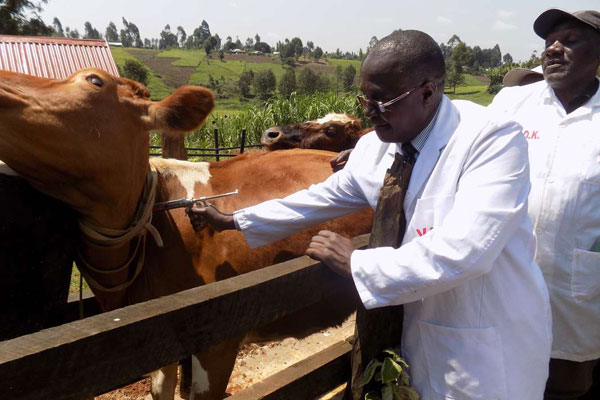
The government will begin a planned mass vaccination targeting 22 million cattle and 50 million goats next week.
The vaccination campaign, set to begin next week in Laikipia County, is part of a broader strategy to achieve disease-free status.
The initiative will be implemented at the county level, with County Directors of Veterinary Services (CDVSs) playing a crucial role in its execution.
“The CDVSs are the frontline soldiers because they are responsible for disease control at the county level. The success or failure of this exercise lies in their hands,” Dr Allan Azegele emphasised.
The initiative has faced some initial resistance from veterinary professionals, primarily due to concerns about stakeholder consultation.
President William Ruto wants the livestock vaccinated gainst Peste Des Petitts (PPR), both highly contagious trans-boundary diseases that the government fears might lead to the death of millions of cows and goats and lock Kenya out of the export markets including oil-rich Gulf states.
The mass vaccination, which had faced opposition and became a subject of political discussions, comes at a time the Kenya Veterinary Association insists its questions on the plan—including on vaccine production, personnel to administer the jabs, and questions whether the public was involved enough—have not been answered.
Director of Veterinary Services Dr Allan Azegele says with the threat of diseases, the mass vaccination cannot wait any longer.
Last year, the Kenya Veterinary Association put out a strongly worded statement saying there was no need for mass vaccination.
Dr Azegele says these issues were addressed through extensive discussions with the Kenya Veterinary Association, including a four-hour webinar attended by 438 veterinarians, and at the end of it all, everyone was on the same page.
But the Kenya Veterinary Association says it has not changed its stance, and that it still stands by its statement.
“We told the government the rollout of the programme was hasty and our members at the time had no idea about the programme and only read about it in the papers,” the chairman, Dr Kelvin Osore, said.
“We reached out to the Director of Veterinary Services for a meeting and they walked us through the programme. But we had suggested postponement of the exercise because we felt the government was not ready and secondly, the public was hostile. For a successful vaccination, you need to vaccinate at least 80 per cent of the livestock, but given the hostility on the ground, the government will be lucky to get a 40 per cent turn up. We demanded for a civic education calendar for the public, but they have not given it to us yet,” said Dr Osore.
The association also questioned the capabilities of Kenya Veterinary Vaccines Production Institute (Kevevapi).
“We don’t feel Kevevapi has the capacity to produce the number of vaccines that the government needs. Kevevapi only produces three million vaccine doses in three months. So how will they produce 22 million doses needed for this drive?” Dr Osore posed.
The Kenya Veterinary Association’s key concern is that some counties lack cold storage facilities for any kind of vaccine and therefore have no capacity to participate in this drive.
“Other counties have serious electricity issues. We don’t even have enough veterinary officers to conduct this vaccination. Why can’t the government address this first? So from all our demands, they only met one; meeting our members. But our position still remains postpone this, roll out civic education, capacity build Kevevapi and hire the necessary officers. Remember we need the public to bring the animals. As long as there is no trust, the drive will fail. This lack of trust is now starting to affect any other vaccination drives, particularly from the counties. People are asking if this is that foreign vaccine,” Dr Osore said.
When the government made the announcement for the mass production, it took a commanding tone, and even said that the vaccination was mandatory for all livestock farmers.
The State has since clarified that no one will be forced to vaccinate their livestock, but Dr Azegele, the Director of Veterinary Services, says the situation is dire—and that prevention is better than cure.
“We have to be proactive rather than reactive. We cannot wait for the disease because it is more expensive to respond to outbreaks,” Dr Azegele stated.
He noted that as a viral disease, FMD has no specific treatment, making prevention through vaccination crucial.
Addressing recent speculation about foreign involvement in the vaccination program, Dr Azegele has maintained that this is entirely a Kenyan-driven initiative.
“The vaccines are sourced from our labs, which have been producing since 1964. We have an FMD lab in Embakasi, and every batch undergoes a second level of quality control in Ethiopia under the African Union,” he clarified.
Alongside FMD, authorities are also addressing other significant livestock diseases, including Peste des Petits Ruminants (PPR) and Contagious Bovine Pleuropneumonia, particularly in beef-producing regions.