Published on April 15, 2026 by Kariuki Mwangi
Last Updated on 2 months by Kariuki Mwangi
Kenya Railways Managing Director Philip Mainga is increasingly emerging as one of the most influential figures in Kenya’s infrastructure sector, with recent high-profile developments elevating his status both locally and on the global stage.
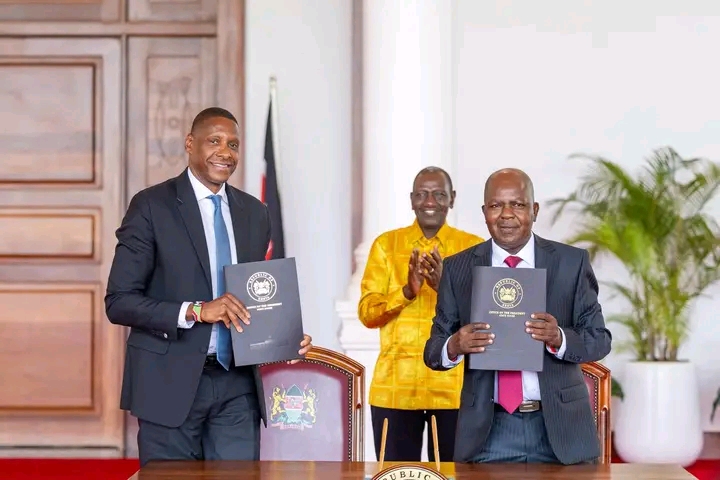
The latest boost to his profile came with the signing of the Nairobi Railway City arena deal at State House, presided over by President William Ruto.
The agreement between Kenya Railways and international partners to construct a modern arena and entertainment complex in Nairobi’s CBD is being viewed as a game-changer in urban infrastructure development.
More significantly, the choice of State House as the venue for the signing underscored the President’s confidence in Mainga’s leadership and his ability to steer complex, high-value projects.
The Nairobi Railway City project, which integrates transport, business, and recreation, signals a shift in how Kenya Railways operates—transitioning from a traditional transport agency into a key player in integrated urban development. Under Mainga, the corporation is increasingly attracting global investors, positioning Kenya as a competitive destination for large-scale infrastructure partnerships.
Beyond the capital, Mainga’s growing influence is anchored in the rapid rollout of rail projects across the country. Recently, President Ruto launched the rehabilitation of the Voi–Taveta metre gauge railway, a strategic corridor linking Kenya to Tanzania.
The revival of this line is expected to boost regional trade and open up economic opportunities in the coastal and lower eastern regions.
At the same time, momentum is building around the planned extension of the Standard Gauge Railway from Naivasha through Kisumu to Malaba.
This ambitious project is central to Kenya’s long-term logistics strategy, aiming to connect the port of Mombasa to the broader East African hinterland.
While the project has faced financing and logistical hurdles in the past, renewed government focus has placed it back on track, with Kenya Railways playing a pivotal coordinating role.
Industry observers note that the speed and scale at which these projects are being pursued reflect Mainga’s commitment to delivering results within a limited timeframe.
With his tenure widely believed to be nearing its final phase, there is a clear push to complete key legacy projects and reposition the corporation for the future.
The combination of the Nairobi arena deal, the revival of metre gauge lines, and the continued expansion of the SGR network has significantly strengthened Mainga’s standing in Kenya’s procurement space.
His ability to oversee multi-billion-shilling deals while maintaining government confidence has made him a central figure in the country’s development agenda.
As Kenya accelerates its infrastructure ambitions, Mainga’s leadership is increasingly being recognized beyond national borders. His recent track record paints the picture of a technocrat determined to finish strong—cementing a legacy defined by transformation, global partnerships, and a bold reimagining of Kenya Railways.