Published on June 22, 2026 by Kenya Online News
Last Updated on 19 hours by Kenya Online News
Will Mt. Kenya ever truly know peace?
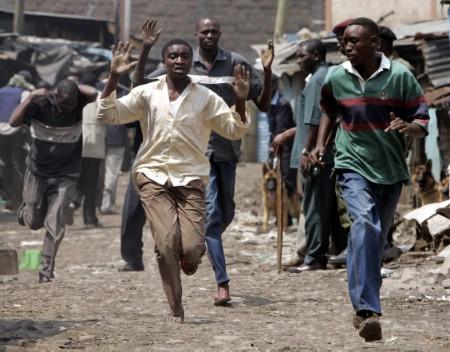
As Kenya marks decades of independence, parts of the Mt. Kenya region can still feel trapped in a cycle reminiscent of the Mau Mau era, only now, the violence is increasingly homegrown, and ordinary members of the Kikuyu community are often caught in the middle. From the Kagumo–Karatina killings and the violence in Ol Kalou to the bloodshed surrounding Githunguri, ordinary citizens remain the grass that suffers when elephants fight.
When we think of undeserving victims of violence, many remember Baby Pendo and Rachel Wandeto, a Kenyan gospel musician who tragically passed away in May 2026 after suffering severe burns from a brutal assault. public speculation and media reports heavily linked the crime to a tattoo of President William Ruto on her body,
On May 16, 2026, Rachel Wandeto was ambushed in the Mwiki area of Kasarani, Nairobi. Attackers doused her with petrol and set her ablaze. She suffered burns covering roughly 70% to 75% of her body and tragically succumbed to her injuries at Kenyatta National Hospital a few days later.
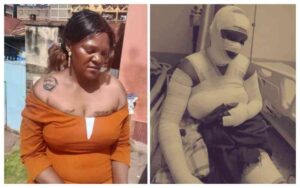
Weeks prior to the attack, Wandeto had gained significant attention online after getting a prominent tattoo of President William Ruto and his political slogans. Because of this, initial rumors and even early police hypotheses pointed toward political intolerance as the driving force behind the violence. But we all know who she had angered coming from the same community that directly and heavly is opposed to Ruto’s next term campaign. The Kikuyu don’t kill people, they can be intolerant to sympathizers verbally or otherwise, but they have people that does dirty work for that matter: the Mungiki.
However, Wandeto are among the new figures, heroes or victims of circumstance brought to light by the shadows of the Mungiki. One of those like her is Mary Wairimo Maina, better known as Mimo, a young woman from Githunguri, Kiambu County.
“Huyu dame alirushia nyuki mawe, lazima angatwe” which loosely translates to, “The lady rattled killer bees, she has to face the consequence or be stung.”

It is narrated that Mary Wairimo joined the Mungiki with unknown intentions, but refused to undergo female genital mutilation (FGM), a practice deeply associated with traditional ceremonies linked to the outlawed movement. Instead of submitting, she began speaking out against it. How brave does someone have to be, or how many lives do you need to have, to take that stand?
Her opposition pulled other young women into the conflict, drawing rumors and accusations, including allegations that she was having lesbian affairs with the other rebel girls. Some reportedly disappeared into hiding, while others suffered violence. In the Mungiki world, defying such orders and living to tell the tale is virtually unheard of. Your guess is as good as mine on what she had coming to her.
Then came Githunguri, the straw that broke the camel’s back.
This followed the protests surrounding the Githunguri Kia Wairera debacle a 58-acre site regarded by the Agikuyu community as a sacred historical place connected to colonial-era struggles, detention, and executions. The site recently returned to national attention when the High Court halted an affordable-housing project following fierce resistance by Kikuyu elders who cursed the government project. Amidst the chaos, active killings occurred in the dark by local sect elements, And the active killing in the dark in isolation to rid the community of few bad apples according to the Mungiki sects even though initially Hon. Gathoni was Muchomba was seen to the bigger enemy though untouchable. Maybe they saw her as an enemy to negotiate with.
Mimo’s story is disturbing not simply because of what is narrated that happened to her, but because of the larger question it raises: what happens to people who walk away from powerful, secretive organizations after seeing what happens behind closed doors?
For someone in that position, escape is only the beginning.
Her story should therefore not be reduced to gossip, sensationalism, or a simple tale of a hero and a villain. It is a warning about what happens when fear, secrecy, violence, and loyalty become intertwined, and when breaking away can be as dangerous as joining.
Yet, perhaps there is another question we must eventually confront.
After we have demonized everyone, labeled everyone a threat, and reduced entire communities to victims or perpetrators, how do we begin putting society back together?
How do we humanize the people on every side of these conflicts? How do we create a path where victims can live without fear, former members can return to ordinary lives, families can stop looking over their shoulders, and communities no longer feel compelled to protect themselves through suspicion and violence?
How do we get people back to their homes, their families, their work, and their ordinary lives without fear of what tomorrow might bring?
That may be the hardest question of all.
Can Mt. Kenya return to a place where people no longer have to choose between silence, fear, and survival? And, after everything that has happened, is that kind of peace still possible?